.png)
KSM-66® Ashwagandha: Complete Benefits, Dosage, Safety Guide

Updated: Mar 8
If you’ve been seeing Ashwagandha or KSM-66® everywhere lately and wondering whether it’s actually worth your attention, you’re not alone.
People are hearing that KSM-66 can help with stress, sleep, energy, hormone balance, even gym performance… and at the same time, they’re worried about side effects, dosage, and long-term safety.
This guide is designed to be your calm, science-based overview of KSM-66® ashwagandha - what it is, what research actually says, how people typically use it, and what you should discuss with your healthcare provider before trying it.
ℹ️ Important: This article is educational only and does not replace medical advice. |

Table of Contents |
What Is KSM-66® Ashwagandha?
KSM-66 is a specific, branded extract of Withania somnifera — the plant most people know as ashwagandha, a key herb in Ayurvedic medicine.
While “ashwagandha” is the general name, KSM-66® refers to a particular root-only extract that’s standardized and manufactured by one company (Ixoreal Biomed). It’s now widely used as an ingredient in many stress, sleep, and performance supplements.[1]
The Origins and Science Behind Ashwagandha
Ashwagandha has been used for thousands of years in Ayurveda as a rasayana — a rejuvenating herb traditionally associated with resilience, vitality, and longevity. Historically, practitioners used it to help people who felt:
Chronically fatigued or “burned out”
Weak or recovering from illness
Stressed, anxious, or mentally drained
Struggling with sleep or low vitality
Modern science has taken those traditional uses and started testing them with randomized controlled trials (RCTs) and systematic reviews:
A 2024 meta-analysis of nine trials (558 participants) found that ashwagandha extracts significantly reduced perceived stress, anxiety scores, and serum cortisol compared with placebo in stressed adults. Doses ranged from 125–600 mg/day for 30–90 days.[2]
A 2022 dose–response meta-analysis also concluded that ashwagandha supplementation yielded beneficial effects on both stress and anxiety, but called for more high-quality trials. [3]
A 2021 systematic review and meta-analysis of five RCTs (400 participants) reported that ashwagandha extract had a small but significant positive effect on sleep, especially at ≥600 mg/day for at least 8 weeks. [4]
Recent narrative and critical reviews summarize growing evidence for ashwagandha supporting stress, fatigue, sleep, cognitive function, and well-being, while emphasizing that long-term safety and optimal dosing remain open questions. [5][6]
So, while ashwagandha is not a magic cure for anything, there is a growing body of research suggesting it may help support stress response, sleep, mood, and cognitive performance in some people.[1][5]
Why KSM-66® Is the “Gold Standard” Root Extract
Within the broader world of ashwagandha, KSM-66 has stood out because of:
Root-only extract
Many traditional formulations focused on the root. KSM-66 is a full-spectrum extract made only from the root, aiming to mirror the traditional profile while being standardized.[5]
Standardized withanolide content
Withanolides are a family of active compounds thought to contribute to ashwagandha’s effects. KSM-66 is standardized to a consistent withanolide level, which helps manufacturers deliver more predictable doses from capsule to capsule.[5]
Clinical research using the exact ingredient “KSM-66”
Several RCTs have used KSM-66 specifically, not just generic ashwagandha. For example, a 60-day trial in chronically stressed adults using 600 mg/day of high-concentration full-spectrum root extract (KSM-66) found significant reductions in stress scores and ~28% lower serum cortisol vs placebo. [5][7]
Because of this combination - traditional root focus + standardized extract + branded clinical data - many brands market KSM-66 as a “gold standard” form of ashwagandha.
Important nuance: “Gold standard” is a marketing phrase, not an official medical designation. Other ashwagandha extracts and plain root powders may also be effective. What matters most is quality, dosage, and whether it’s appropriate for you.
KSM-66® vs Regular Ashwagandha: Key Differences
When you’re shopping, you might see:
“Ashwagandha powder”
“Ashwagandha extract”
“KSM-66® ashwagandha”
Or blends with multiple herbs
Here’s a simple comparison to help you understand the differences:
Feature | KSM-66® Ashwagandha (Root Extract) | Regular Ashwagandha Powder / Generic Extract |
Plant part used | Root only (full-spectrum root extract) | Root, or root + leaf, or not specified |
Standardization | Yes, withanolides at a defined level | Varies widely; sometimes not standardized |
Clinical research | Multiple trials using the exact KSM-66 extract | Trials often use “ashwagandha extract” more generically |
Typical dosage in supplements | 300–600 mg/day in many products and trials | Can range from a few hundred mg to several grams of plain powder |
Label transparency | Usually clearly states “KSM-66®” and dosage per cap | Some products list only “ashwagandha” without extract details |
KSM-66 isn’t automatically “better” for everyone, but if you want a root-only extract with fairly consistent clinical data and dosing, it’s one of the better-studied options currently available. [5][6]
Full detailed comparison: KSM-66® vs Other Ashwagandha Extracts: Key Differences Explained
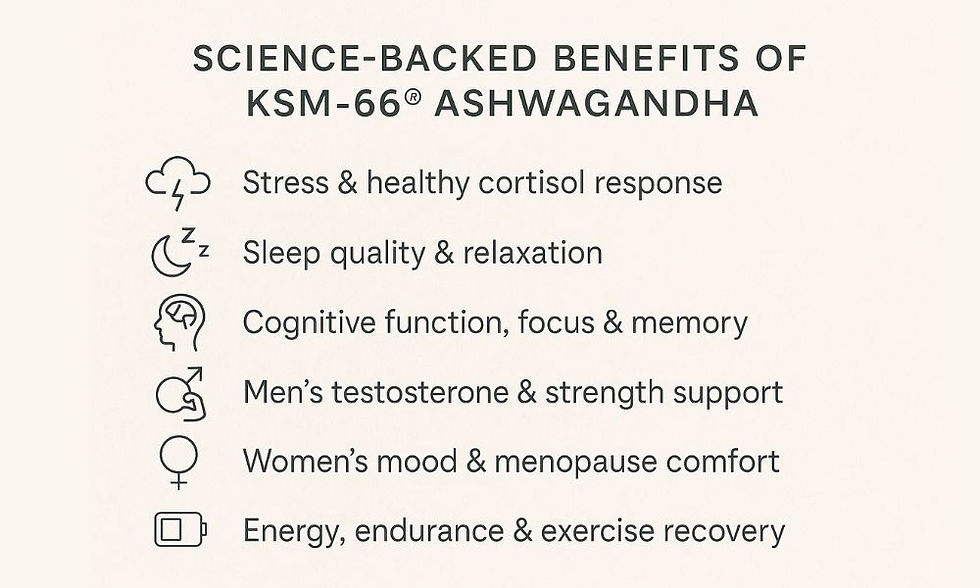
The Science-Backed Benefits of KSM-66 Ashwagandha
Stress and Cortisol Support: What Research Suggests
Multiple clinical trials suggest that standardized ashwagandha root extracts can help reduce perceived stress scores and support lower serum cortisol levels over about 6–8 weeks in some adults.[2][7]
These findings form part of the rationale for using KSM-66® ashwagandha as a tool for stress support and healthy cortisol response in appropriate adults.
In real life, people who respond often describe it less as a sedative and more as a “mental buffer,” helping daily pressure feel more manageable and less likely to tip into burnout.
Important: Even with promising data, lifestyle habits and psychological support remain just as important as any herb. Anyone with significant anxiety, depression, or other mental health concerns should seek professional care and not rely on supplements alone.[1][6]
Sleep Support: Sleep Quality and Duration
Ashwagandha is increasingly discussed for its potential restorative effects on sleep. A 2021 meta-analysis of clinical trials suggests that ashwagandha extract may improve sleep efficiency, helping some people fall asleep faster and stay asleep longer over several weeks of use.[4][8]
How it works: Instead of acting like a fast-acting sedative, ashwagandha appears to work more gradually, likely by supporting a calmer nervous system rather than forcing a “knockout” effect.
Note: Good sleep hygiene is still essential. KSM-66® is best viewed as a supportive addition to a healthy routine, not a replacement for habits like a regular sleep schedule, managing caffeine, and limiting late-night screen time.
Men’s Health: Testosterone and Muscle Strength Support
KSM-66® ashwagandha has become a staple in some men’s performance routines. Current research suggests it may help support:
Hormonal balance: helping maintain testosterone levels already within the normal range.
Hormonal balance: helping maintain testosterone levels already within the normal range.
Reproductive health: supporting sperm parameters such as motility in certain study populations.
Important: KSM-66® is not an anabolic steroid. It may support performance under stress, but it does not replace sleep, nutrition, or medical care. Men with hormonal conditions or fertility treatment should consult a clinician before use.[1]
Full men’s guide: KSM-66® Ashwagandha for Men: Testosterone and Strength Support
Women’s Stress, Mood and Menopause Support
Beyond general wellness, KSM-66® may also help support women’s unique needs by easing the effects of the “cortisol steal.” Early research suggests potential benefits for:
Hormonal Mood Support: Helping smooth out irritability and stress-related mood changes.
Menopause Comfort: May help ease hot flashes and night-time sleep disruption in some women [5][6].
Sexual Health: May support arousal, satisfaction, and overall intimacy.
Safety note: Ashwagandha supplements, including KSM-66®, are generally not recommended during pregnancy or breastfeeding. Always talk with your healthcare provider first.
Want a deeper dive? We’ve created a KSM-66® ashwagandha for women guide on stress, mood, and menopause support.
Cognitive Function, Focus, and Memory Support
Some studies and reviews have explored ashwagandha’s role in:
Cognitive performance (attention, processing speed, memory)
Mental clarity and subjective focus
Results are promising but early:
In some trials, adults taking standardized ashwagandha extracts performed better on certain memory and attention tasks vs placebo.
Proposed mechanisms include stress reduction, antioxidant activity, and possible modulation of GABAergic and serotonergic pathways. [5]
People who respond often describe “a little less brain fog” or easier concentration on tasks, but this is supportive, not a treatment for serious cognitive disorders or ADHD.
Energy, Endurance, and Athletic Performance Support
As an adaptogen, KSM-66 is often marketed to athletes and active individuals. Emerging research shows ashwagandha supplementation can:
Improve cardiorespiratory endurance
Enhance VO₂ max
Support resistance training performance and recovery [9][10][12]
In practice, some people report:
More “steady” daytime energy
Better stamina during workouts
Less subjective fatigue afterward
Results are not universal, and stimulants like caffeine have more immediate effects (with their own risks). KSM-66 is better thought of as a long-term support rather than an acute performance booster.
If you train regularly, our KSM-66® pre- and post-workout timing guide walks through how athletes often schedule their doses.
Other Potential Benefits (Immune Support, Thyroid Function)
Evidence is more nuanced:
A double-blind RCT in people with subclinical hypothyroidism (300 mg ashwagandha twice daily for 8 weeks) found improved thyroid hormone levels in some participants. [13]
Reviews note possible modulation of immune markers, but emphasize that more robust long-term human trials are needed before making strong thyroid or immune claims. [6]
If you have thyroid disease, autoimmune conditions, or immune compromise:
Do not self-treat with KSM-66
Always consult your endocrinologist or relevant specialist [1][6]
Recommended KSM-66® Dosage for Optimal Results
There’s no one-size-fits-all answer, but we can look at how KSM-66 and similar root extracts have been used in clinical studies. [2][4][7][9]
General Daily Dosage Guidelines
A typical “starting point” people discuss with their providers might be:
300 mg/day for general stress support and sensitivity testing
Potentially increasing to 600 mg/day, if well-tolerated and advised by a professional
Short-term use (up to ~3 months) is where we have the strongest safety data. [1][9]
Dosage by Specific Goals (Stress, Sleep, Testosterone)
Here is an educational summary based on clinical trial patterns:
Goal (Research Context) | Common Dose Range Used in Studies | Typical Duration in Trials |
Stress & anxiety support | 300–600 mg/day | 6–8 weeks |
Sleep support | ~600 mg/day | 8+ weeks |
Testosterone/men’s health | 600 mg/day (often split dosing) | 8–12 weeks |
Performance/endurance | 300–600 mg/day | 8–12 weeks |
[2][4][7][9][10]
These are study patterns, not prescriptions. Real-world use must be individualized.
Timing & Usage Tips
Take with food: Ashwagandha can cause mild stomach upset on an empty stomach. Taking it with breakfast or dinner is generally recommended.
Morning vs. Night: Morning intake favors calm energy, while evening intake supports sleep quality or split doses.
Cycle: Use 6–12 weeks, then break, as long-term data is limited. [1][9]
For a step-by-step routine, you can follow our guide on how to take KSM-66® ashwagandha, with dosage and timing tips.
KSM-66® Safety Profile and Side Effects
Even when a supplement is “natural,” it still affects your body chemistry. One of the most important parts of evaluating KSM-66 is understanding safety and side effects.
Always remember: “Generally safe for most healthy adults” does not mean “safe for everyone in every situation.”
Common Side Effects and How to Avoid Them
In short-term trials (8–12 weeks), KSM-66® is generally well-tolerated. However, some users may experience mild reactions, including:
Digestive discomfort: Nausea, stomach upset, or diarrhea (often caused by taking it on an empty stomach).
Drowsiness: Feeling "too relaxed" or sleepy during the day.
Headache: Usually transient in the first few days.
Who Should Avoid KSM-66®?
Current evidence suggests you should avoid or strictly monitor usage if you:
Are pregnant or breastfeeding (risk of uterine contraction).
Have autoimmune diseases (may stimulate the immune system).
Have thyroid disorders or take thyroid medication.
Have existing liver conditions.
Serious Risks & Drug Interactions
Although rare, serious adverse events like liver injury have been reported in global pharmacovigilance data. Additionally, KSM-66® can interact with sedatives, blood pressure meds, and thyroid medication.
Want to use KSM-66® safely? For a deeper dive, see our full guide on KSM-66® side effects, safety, risks and warnings.
How to Choose a High-Quality KSM-66 Ashwagandha Supplement
Once you’ve decided KSM-66 might be worth exploring with your doctor, the next practical question is:
“How do I choose a good product and avoid something sketchy?”
How to Confirm You’re Getting Genuine KSM-66®
Because KSM-66 is a trademarked ingredient, legitimate products should:
Use the name “KSM-66® ashwagandha root extract” on the Supplement Facts or ingredients list
Often indicate that KSM-66 is supplied by Ixoreal Biomed (the original manufacturer)
State a clear dose per serving (e.g., 300 mg or 600 mg) [5][6]
If a label simply says “ashwagandha” with no mention of KSM-66, root-only, or standardization, it’s likely a generic ashwagandha product.
Capsules vs Powders vs Blends: Which Format Fits You?
KSM-66 is most commonly found in capsules and multi-ingredient blends, though some powders are available too. Each format has trade-offs:
Capsules
✅ Pros: easy dosing, convenient, no taste
❌ Cons: less flexible for micro-adjusting doses
Powders
✅ Pros: can be mixed into smoothies or drinks, potentially flexible dosing
❌ Cons: stronger taste, harder to guarantee precise dose each time
Blends (KSM-66 + other ingredients)
For example:
KSM-66 + L-theanine (calm focus)
KSM-66 + magnesium or B-complex (stress & nervous system support)
KSM-66 + sleep herbs
Pros: can target multiple aspects (stress, sleep, recovery)
Cons: more complex to assess what’s helping or causing side effects; higher chance of interactions
If you’re new to ashwagandha, many people prefer starting with a simple single-ingredient KSM-66 capsule, then adding more complexity later if needed.
Is KSM-66® Ashwagandha Right for You?
Even if KSM-66® looks promising, it won’t be right for everyone. Before you start, it helps to review:
Your main goal (stress relief, sleep, gym performance, or hormone-related well-being).
Your health context (thyroid or autoimmune issues, pregnancy/breastfeeding, liver or kidney disease, current medications).
Your willingness to test it carefully for 6–8 weeks, keep a simple log, and stop if side effects appear.
If any of these raise questions, it’s a good moment to involve your doctor. For a full checklist of “green light / yellow light / red light” situations and conversation starters to bring to your clinician, see: Is KSM-66® Ashwagandha Right for You? Read This Guide First.
Conclusion: Why KSM-66® Ashwagandha Stands Out
KSM-66® ashwagandha is a well-studied root extract that may help support stress response, sleep quality, cognitive function, and aspects of men’s and women’s health when used thoughtfully. It’s not a cure or replacement for medical care or healthy habits, but it can be one useful tool within a broader wellness plan if you choose a high-quality product and work with a healthcare professional to find the right dose and duration.
If you decide to explore KSM-66, track how you feel over time, stay alert to side effects, and keep your decisions grounded in both evidence and your own real-life experience.
FAQ
How long does it take to feel KSM-66® ashwagandha?
Most meaningful changes in stress or sleep appear over 6–8 weeks in trials, not overnight. Some people notice subtle shifts within 1–2 weeks; others may not notice clear changes at all.
Can KSM-66® be combined with other supplements?
Yes, but combinations should be intentional and supervised, especially if:
You already take prescription meds
Your stack includes multiple calming or sedating agents
Always check for interactions and avoid “kitchen sink” stacks.
When is the best time to take KSM-66® – morning or night?
There’s no one best time:
Morning/midday: stress resilience and daytime calm
Evening: sleep support or wind-down routine
Split dosing: half in the morning, half at night
The best timing is the one that fits your body, schedule, and overall regimen. [4][8]
For more scenarios and examples, see our guide on the best time to take KSM-66® ashwagandha, morning vs night.
What if I experience side effects?
For mild issues (e.g., minor stomach upset, light drowsiness):
Try taking with food
Lower your dose (if your provider agrees)
Adjust timing
For persistent, significant, or worrying symptoms, stop and contact your doctor promptly.
Is KSM-66® better than regular ashwagandha?
“Better” depends on your priorities:
KSM-66 offers standardized root-only extract with specific clinical trials behind it. [5][6]
Quality generic root extracts may also be reasonable when well-sourced and tested.
If you want the closest match between clinical data and your supplement label, KSM-66 has an advantage.
References
[1] NIH Office of Dietary Supplements. Ashwagandha: Is it helpful for stress, anxiety, or sleep? Health Professional Fact Sheet. 2025. https://ods.od.nih.gov/factsheets/Ashwagandha-HealthProfessional/
[2] Arumugam V, et al. Effects of Ashwagandha (Withania somnifera) on stress, anxiety and cortisol levels in adults: A meta-analysis of randomized controlled trials. Complementary Therapies in Medicine. 2024. https://www.sciencedirect.com/science/article/pii/S1550830724001691
[3] Akhgarjand C, et al. Does Ashwagandha supplementation have a beneficial effect on stress and anxiety? A systematic review and dose–response meta-analysis of randomized controlled trials. 2022. PubMed ID: 36017529. https://pubmed.ncbi.nlm.nih.gov/36017529/
[4] Cheah KL, et al. Effect of Ashwagandha (Withania somnifera) extract on sleep: A systematic review and meta-analysis. PLOS ONE. 2021;16(9):e0257843. https://journals.plos.org/plosone/article?id=10.1371/journal.pone.0257843
[5] Wiciński M, et al. Ashwagandha (Withania somnifera) and Its Effects on Well-Being: A Critical Review. Nutrients. 2025;17(13):2143. https://www.mdpi.com/2072-6643/17/13/2143
[6] Sprengel M, et al. Withania somnifera (Ashwagandha) supplementation and health outcomes: An overview of clinical evidence. 2025. https://pmc.ncbi.nlm.nih.gov/articles/PMC11800443/
[7] Chandrasekhar K, et al. A prospective, randomized double-blind, placebo-controlled study of safety and efficacy of a high-concentration full-spectrum extract of Ashwagandha root in reducing stress and anxiety in adults. Indian Journal of Psychological Medicine. 2012;34(3):255–262. https://pmc.ncbi.nlm.nih.gov/articles/PMC3573577/
[8] Cheah KL, et al. Effect of Ashwagandha on sleep quality in healthy adults. Subgroup details in [4].
[9] Verma N, et al. Safety of Ashwagandha root extract: A randomized, placebo-controlled study in healthy volunteers. Phytomedicine. 2021. https://www.sciencedirect.com/science/article/pii/S0965229920319099
[10] Shenoy S, et al. Effects of eight-week supplementation of Ashwagandha on cardiorespiratory endurance in elite Indian cyclists. Journal of Ayurveda and Integrative Medicine. 2012;3(4):209–214. https://pmc.ncbi.nlm.nih.gov/articles/PMC3545242/
[11] Lubarska M, et al. Ashwagandha-induced liver injury — A case report. Cureus. 2023. https://pmc.ncbi.nlm.nih.gov/articles/PMC10002162/
[12] Björnsson HK, et al. Ashwagandha-induced liver injury: A case series from Iceland and the U.S. Liver International. 2020;40(4):825–829. https://onlinelibrary.wiley.com/doi/10.1111/liv.14393
[13] Sharma AK, et al. Efficacy and Safety of Ashwagandha Root Extract in Subclinical Hypothyroid Patients: A Double-Blind, Randomized Placebo-Controlled Trial. Journal of Alternative and Complementary Medicine. 2018. PubMed ID: 28829155.


.png)
.png)


