.png)
How to Take KSM-66® Ashwagandha: Dosage and Timing Tips

Updated: Jan 4
If you’ve finally picked up a bottle of KSM-66® ashwagandha but now find yourself staring at the label thinking, “How much should I take? Morning or night? With food or on an empty stomach?” - you’re exactly who this guide is for.
KSM-66 is one of the most researched forms of ashwagandha root extract, and many people use it to support stress, sleep, focus, and performance. But if you use the wrong dose or timing, you might end up with an upset stomach, feeling too drowsy at the wrong time of day, or simply not noticing any effect at all.
This article walks you step by step through how to take KSM-66 ashwagandha: how much to take, when to take it, how to pair it with food, and how long to use it - all grounded in clinical research patterns and practical experience.
ℹ️ Important This guide is for educational purposes only and does not replace medical advice. |
For a deep dive into the science behind why this herb works, check out our Complete Benefits, Dosage, and Safety Guide to KSM-66® Ashwagandha.
Quick Answer – How Most People Take KSM-66®
Typical Dosage: 300 mg to 600 mg per day in adults over 6–12 weeks.[1–4]
Best Time:
Morning: For calm energy and stress resilience during the workday.
Evening: For sleep support and winding down.
Split dose: A common approach in trials looking at stress and performance.
There’s no single best time for everyone. It depends on your goals and how your body responds.
With Food? Yes. It is highly recommended to take KSM-66 with a meal or a fat source (like milk or nut butter) to prevent stomach upset and improve absorption.
Duration: Clinical benefits for stress and sleep usually peak after 6–8 weeks of consistent use.
Safety Check: Always consult your doctor before starting, especially if you have thyroid conditions, autoimmune diseases, or are pregnant/breastfeeding.
Step 1 – Understand What You’re Taking
“Ashwagandha” is the common name for Withania somnifera, used in Ayurveda for centuries as a rasayana — a rejuvenating herb for resilience and vitality.[5]
KSM-66® is a specific, branded, root-only extract of ashwagandha that’s full-spectrum and standardized, so key compounds like withanolides stay within a consistent range from batch to batch.[5,6] It has been directly studied in several randomized controlled trials looking at stress, anxiety, sleep, and physical performance.[2–4,6]
Overall, standardized root extracts like KSM-66 may help support perceived stress, sleep quality, recovery, aspects of men’s hormone health, energy, and cognitive performance - but they are not cures and should only complement, not replace, medical care and core lifestyle habits such as sleep, nutrition, movement, and mental health support.[2–6]
Step 2 – Choose Your Starting Dosage
Looking across modern clinical trials of ashwagandha root extracts, including KSM-66, we see a clear pattern:
Most adult studies use: 300–600 mg per day
Typical duration: 6–12 weeks[2–4,6]
A few examples:
A trial in chronically stressed adults used 600 mg/day of KSM-66 (300 mg twice daily) for 60 days and reported significant reductions in perceived stress and serum cortisol compared with placebo.[2]
A meta-analysis on sleep found that ashwagandha extracts at ~600 mg/day for at least 8 weeks improved sleep quality and total sleep time more than placebo in several small RCTs.[4]
Strength and performance studies often used 300–600 mg/day, sometimes split into two doses.[7]
From a practical angle, for many adults:
300 mg/day is a reasonable starting point to see how your body responds
600 mg/day is a typical “full” dose used in many trials, assuming you tolerate it and your doctor agrees
Beginner Protocol (Educational Example, Not a Prescription)
Week 1:300 mg once daily with food (usually breakfast or lunch). Track your mood, stress, sleep, and digestion.
Week 2–4:If you feel fine and your provider agrees, you might increase to 600 mg/day (usually two capsules)
Week 4–8: Evaluate benefits and side effectsDo you feel calmer, sleep a bit better, or recover better from daily stress or training? Any new or persistent side effects?
Step 3 – With or Without Food?
Once you’ve settled on a starting dose, the next very practical question is: “Should I take KSM-66 on an empty stomach or with a meal?”
This simple detail can make a big difference in how you feel.
Why Taking KSM-66® With Food Is Usually Best
Ashwagandha can cause nausea, stomach discomfort, or loose stools in some people, especially if taken on an empty stomach or at higher doses.[1,5]
Taking KSM-66 right after a meal or snack can help:
Buffer the stomach lining
Improve comfort and tolerance
Make it easier to remember (e.g., “always after breakfast”)
If you’re unsure how your stomach will react, it’s safest to start with food, not on an empty stomach.
Can I take it on an empty stomach?
Technically, yes. If you have an "iron stomach" and value convenience above all else, you can try it. However, if you experience even mild queasiness, do not force it. Switch immediately to taking it mid-meal.
Step 4 – Choose the Best Time of Day: Morning, Evening, or Split

Morning Routine – For Daytime Stress and Calm Focus
If you want support for work stress, clear thinking, and calm focus, morning dosing is a common choice:
Take 300–600 mg with breakfast
Or 300 mg with breakfast, 300 mg with lunch (for a split dose)
Evening Routine – For Wind-Down and Sleep Support
If your main goal is sleep and evening relaxation, taking KSM-66 later in the day may make more sense.
Typical pattern:
300–600 mg about 1–2 hours before bedtime, usually with a light snack
Some insomnia or sleep-quality trials used 600 mg/day, often in the evening over at least 8 weeks[4]
Split Dosing – Morning and Night
If you want both daytime and night-time support, you might split your dose:
300 mg with breakfast + 300 mg in the evening
Total: 600 mg/day, which matches many clinical trial doses [2–4]
If your biggest question is “is morning or night better for me?”, check out our in-depth Best Time to Take KSM-66® Ashwagandha: Morning vs Night article for a more detailed comparison of the options.
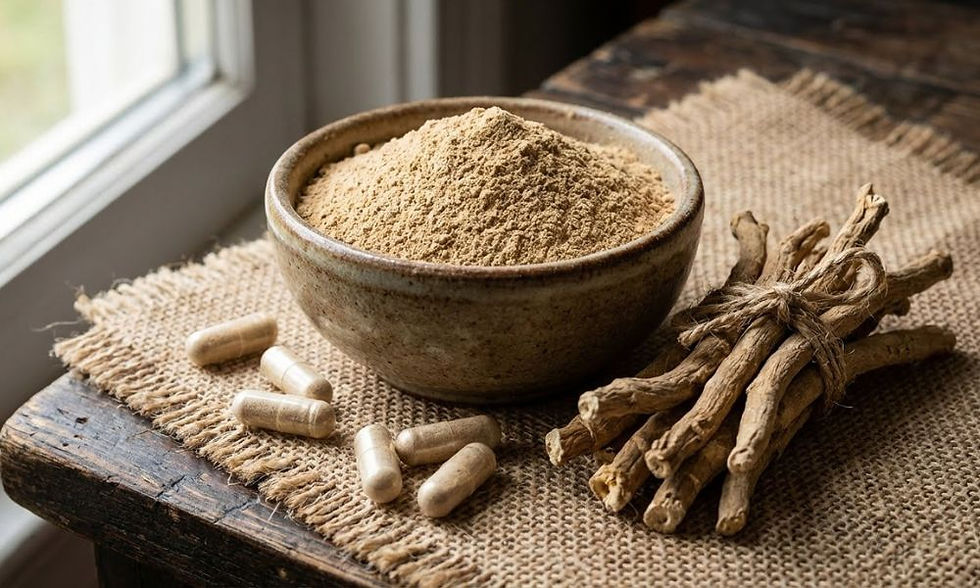
Step 5 – Capsule vs Powder: Which Format Is Right for You?
KSM-66 is mostly sold as capsules, but sometimes appears in powders or blends.
Capsules are usually the easiest option:
Pros: convenient, portable, no taste, and consistent dosing (for example, 300 mg per capsule)
Cons: less flexibility if you want to adjust by very small amounts, and not ideal if you dislike swallowing pills
Powders are more common with generic ashwagandha but may also exist with KSM-66 in some products:
Pros: flexible dosing; easy to mix into smoothies or warm drinks
Cons: strong, earthy, bitter taste and smell; harder to measure precisely without a good scoop or scale
If you consider powder, check whether it is root-only or root + leaf, whether it is standardized, and whether the brand shares third-party testing results. Capsules are typically better for straightforward, accurate dosing, especially if you’re just starting.
Step 6 – How Long Should You Take KSM-66®? (Duration & Cycling)
KSM-66® works through gradual adaptation, not instant effects. That raises a big question: How long should you stay on it?
The 8-12 Week Benchmark
Most high-quality clinical trials on KSM-66® run for a duration of 8 to 12 weeks.
Weeks 1–2: You might notice subtle changes (better sleep quality, slightly calmer mood), or nothing at all.
Weeks 4–8: Clearer improvements in stress and sleep scores in responders
Recommendation: Commit to a daily routine for at least 6 - 8 weeks before deciding if it works for you.
Should You "Cycle" (Take Breaks)?
Since we currently lack robust human safety data for continuous use spanning multiple years, many functional medicine practitioners recommend a cycling protocol.
The Protocol: Take KSM-66 for 3 months, then take a break (for example, a few weeks).
The Logic: This "washout" period allows your body’s receptors to reset (resensitize) and ensures you aren't becoming psychologically dependent on the supplement to manage stress. It also gives your liver a break from processing herbal compounds.
If you notice any unusual symptoms - especially fatigue, jaundice, dark urine, or new thyroid-related issues- stop and contact your doctor promptly.
For a deeper look at risks, you can read: KSM-66® Side Effects, Safety, Risks and Warnings.
Common Mistakes When Taking KSM-66®
Expecting Overnight Results
KSM-66 is an adaptogen, not a stimulant. It usually takes several weeks, not days, to notice meaningful changes.[5] Commit to a 6–8 week trial and track your stress, mood, sleep, and energy weekly rather than hour by hour.

Taking It on an Empty Stomach Despite a Sensitive Gut
Some people with sensitive digestion try to be “hardcore” and swallow KSM-66 first thing in the morning with only black coffee. That’s a recipe for nausea or stomach discomfort for many.
Stacking Too Many Calming Supplements (or Mixing with Alcohol)
Ashwagandha can have a mild calming or sedating effect in some people.[1,5] Combining it with:
Alcohol
Sleep or anxiety medications
Multiple other calming herbs/supplements
…can leave you too drowsy, foggy, or unsteady. Always talk with your doctor or pharmacist before building complex “stacks”, especially if you already use prescription meds.
Conclusion
KSM-66 ashwagandha can be a helpful tool for stress, sleep, focus, and performance - when used thoughtfully. The safest, most practical way to use it is to:
Start low (often 300 mg/day)
Take it with food
Choose timing based on your main goal (morning, evening, or split)
Give it at least 6–8 weeks before judging its effect
Work with a healthcare professional, especially if you take medications or have health conditions
Used this way, KSM-66 becomes one part of a bigger picture that still depends on good sleep, nutrition, movement, and emotional support.
FAQ
Can I open the capsule and mix KSM-66® into food or drinks?
Yes, many people open capsules and mix the powder into smoothies, yogurt, or warm milk. Just use the entire capsule so the dose stays accurate, and be prepared for a strong taste.
What should I do if I forget a dose?
Just skip it and continue as normal the next day, don’t “double up” to make up for the missed capsule. If you’re unsure, ask your healthcare provider.
Is it okay to drink coffee if I take KSM-66® in the morning?
Many people do. Some feel a nice “calm focus,” others feel off. If you experiment, start with moderate caffeine and pay attention to how you feel for a few days.
References
[1] NIH Office of Dietary Supplements. Ashwagandha: Is it helpful for stress, anxiety, or sleep? Health Professional Fact Sheet. 2025. Available at: https://ods.od.nih.gov/factsheets/Ashwagandha-HealthProfessional/
[2] Arumugam V, et al. Effects of Ashwagandha (Withania somnifera) on stress, anxiety and cortisol levels in adults: A meta-analysis of randomized controlled trials. Complementary Therapies in Medicine. 2024. Available at: https://pubmed.ncbi.nlm.nih.gov/39348746/
[3] Akhgarjand C, et al. Does Ashwagandha supplementation have a beneficial effect on the management of anxiety and stress? A systematic review and dose–response meta-analysis of randomized controlled trials. Phytotherapy Research. 2022. Available at: https://pubmed.ncbi.nlm.nih.gov/36017529/
[4] Cheah KL, et al. Effect of Ashwagandha (Withania somnifera) extract on sleep: A systematic review and meta-analysis. PLOS ONE. 2021;16(9):e0257843. Available at: https://pmc.ncbi.nlm.nih.gov/articles/PMC8462692/
[5] National Center for Complementary and Integrative Health (NCCIH). Ashwagandha: What You Need To Know. Available at: https://www.nccih.nih.gov/health/ashwagandha
[6] Wiciński M, et al. Ashwagandha (Withania somnifera) and Its Effects on Well-Being: A Critical Review. Nutrients. 2025;17(13):2143. Available at: https://www.mdpi.com/2072-6643/17/13/2143
[7] Shenoy S, et al. Effects of eight-week supplementation of Ashwagandha on cardiorespiratory endurance in elite Indian cyclists. Journal of Ayurveda and Integrative Medicine. 2012;3(4):209–214. Available at:


.png)
.png)


